
The history of bras (brassières; variously pronounced) is inextricably intertwined with the social history of the status of women, including the evolution of fashion and changing views of the female body.
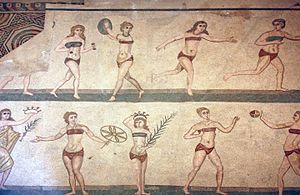
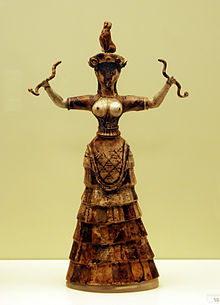
Women have used a variety of garments and devices to cover, restrain, reveal, or modify the appearance of their own breasts. Bra- or bikini-like garments are depicted in some art of female athletes of the Minoan civilization, ca. 14th century BC.[1] From the 14th century onward, the undergarments of wealthier women in the Western world were dominated by the corset, which supported the breasts by transferring their weight to the rib cage[citation needed]. Corsets varied in length from short ones which only supported the bust to longer ones also used to shape the waist. In the latter part of the 19th century, women experimented with various alternatives such as splitting the corset into a girdle-like restraining device for the lower torso and transferring the upper part to devices suspended from the shoulder.[2]
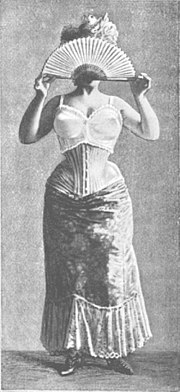
By the early 20th century, garments more closely resembling contemporary bras had emerged, although large-scale commercial production did not occur until the 1930s[citation needed]. Since then bras have replaced corsets (although some women prefer camisoles) and some, as well, go without.[3] The metal shortages of World War II encouraged the end of the corset. By the time the war ended, most fashion-conscious women in Europe and North America were wearing bras. From there the bra was adopted by women in Asia, Africa, and Latin America.[4]
Greece
y-shaped breast bands on a bronze statue of Artemis, goddess of the hunt (mid-4th century BC). These bands form an archery harness, which a quiver of arrows attaches to.Marble statuette of Aphrodite in a gold “bikini”; Roman copy of a Hellenistic original found in Pompeii.
The wearing of a specialized undergarment meant to support a woman’s breasts may date back to ancient Greece. In Book 14 of Homer’s Iliad, written in the archaic period of Classical Antiquity, the poet refers to Aphrodite’s “embroidered girdle” or kestos himas as being “loosed from her breasts,” perhaps indicating that this may be a reference to a decorated breast-band rather than a girdle or belt, as is often interpreted. There is at least one example of late-Hellenic sculpture that seems to confirm this, depicting the goddess wrapping a stróphion (from stróphos “twisted band” + the diminutive suffix -ion) around her chest. [5] However, it is currently impossible to tell whether the stróphion was an everyday garment worn by the average woman or an item of clothing reserved for certain situations or specific types of women. Some sources suggest that it may have been in use as a common undergarment[6] while others are doubtful. There is very little visual evidence for its existence, and even less evidence for its specialized use as an undergarment. Most early Grecian sculpture and vase paintings that depict women in states of undress show no indication of any kind of breast-band, instead revealing the shape of the breast through draped clothing, or even the nipple itself, with no sign of an intervening item of clothing between chiton and skin. The literary evidence is somewhat more plentiful, and the stróphion is mentioned specifically in Aristophanes’ Lysistrata and Women at the Thesmophoria.
Rome
The gold body chain from the Hoxne hoard resembles a jeweled version of the crossed breast bandDetail from a wall painting at Pompeii, 62–79 AD showing a mamillare on an otherwise nude woman
Women in ancient Rome adopted a form of the Greek apodesme, known as the strophium or mamillare. Since the Romans regarded large breasts as comical, or characteristic of aging or unattractive women,[8] young girls wore breast bands (fascia) secured tightly in the belief that doing so would prevent overly large, sagging breasts.[9]
The so-called “bikini girls” mosaic from the Villa Romana del Casale (4th century AD) shows women performing gymnastic or dance routines while wearing a garment similar to a strapless bra and briefs.[10][11] Other primitive iterations of a bra are depicted earlier in wall paintings preserved at Pompeii by the eruption of Vesuvius in 79 AD.[12]
Sometimes in the most sexually explicit Roman paintings, the breasts are kept covered by the strophium. The settings in which the paintings are found indicate that the women depicted may be prostitutes.[13]






 Find_your_special_style

.jpg)

